Woman With Stenosis Can Walk Again
Introduction
Spinal stenosis is a term used to depict a narrowing of the spinal canal that gives rise to symptoms of compression of the spinal nerves or sometimes the spinal cord. Narrowing that affects the spinal cord is too sometimes called a myelopathy. Spinal stenosis is quite a common problem particularly with older people, (nevertheless it can touch on younger people but more rarely.)
The symptoms experienced are those of back pain and leg hurting. Most typically it occurs equally you walk a hurting and will cause numbness or weakness or feelings of unsteadiness sometimes in both legs sometimes in only one.
Claudication is the term used past doctors for weakness of the legs that gets worse specifically on walking. Mutual causes are vascular due to narrowing of the claret vessels or spinal due to os overgrowth causing a reduction in the infinite for spinal nerves.
Classically the sufferer can walk a certain distance (sometimes 50m or further- say -500m) and then they demand to stop because the hurting & numbness intensifies.
Most find that sitting downward or leaning forward enables them to recover then that they can then walk once more.
Some likewise get these symptoms on standing.
Also usually patients have no hurting in the leg at rest.
(Back pain is not the same notwithstanding and increased back hurting on walking is not a feature of spinal stenosis.)
Causes
Commonly as part of the natural aging procedure we develop degenerative alter in the lower back.
Sometimes these changes lead to a partial constriction -or a "stenosis"- of the nerve tunnel within the spine which is chosen the central canal that is "key stenosis".
Others endure a slightly different constriction to the smaller side tunnels with the spine which is called "foraminal stenosis".
Practically speaking the symptoms of each or these 2 types are essentially the same.
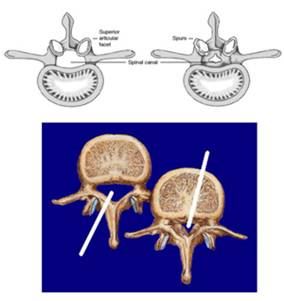
Normal key canal - Narrow central culvert
Clinical Effects
The nerves within the spine are both compressed by the constriction & also their claret supply is temporarily reduced by the pinch.
This leads to the pain on walking, every bit the tunnels in the spine are smaller when you are erect, but larger on sitting with the spine bent.
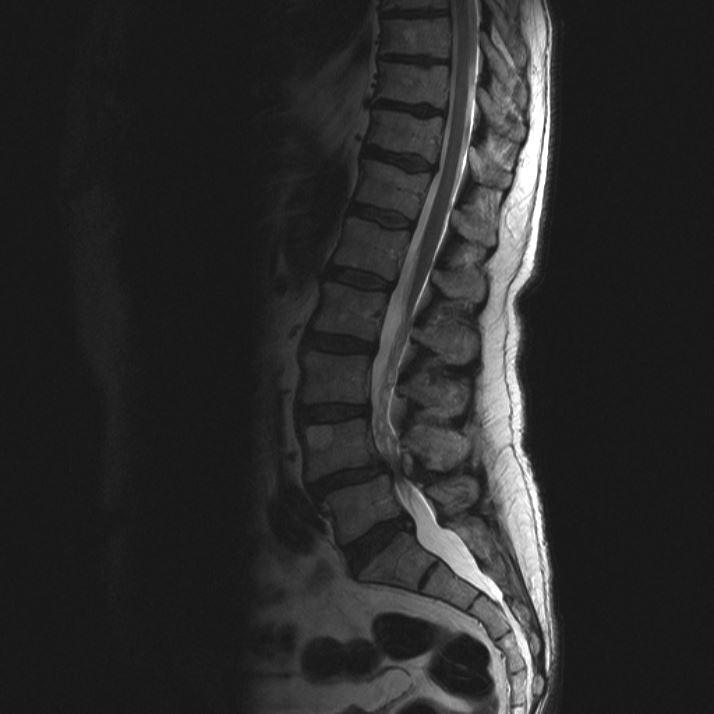 Diagnosis
The trouble is firstly assessed by your GP who makes a clinical diagnosis, then ordinarily asks the opinion of a hospital specialist, who assesses & requests an MRI scan & or rarely CT scan which confirms the problem.
Central culvert stenosis at one place (level) in the lower back.
Some patients tin can accept more than one level affected.
Prognosis
The form of the trouble has some uncertainty, but a general dominion can by applied that ane:5 will improve with time, three:v will stay the aforementioned, &ane:5 will worsen with fourth dimension.
Worsening is usually that the walking distance will reduce gradually & sometimes the nerve supply to the leg will become increasingly affected.
Treatment
his condition is a 'quality of life' upshot. If your symptoms are adequate to you lot then no interventions may be needed.
Most specialists would suggest you start with simple less risky treatments first.
Firstly
Improving spinal mobility, strength & overall fitness
Improving hurting control
Spinal mobility & stability exercises performed routinely.
Static bike cycling niggling and often to start with. Patients can often bike without as much leg pain every bit when they walk. The utilise of an practise bike can enable comeback in fitness and leg musculus tone. Outset with just two or 3 minutes twice a a twenty-four hour period, and increase the time a little each few days.
Walking every bit all-time as possible.
Weight loss if applicable.
Some patients better past these simple measures, and if surgery was needed existence as fit and well as possible means that surgery would be safer as you, the patient, would be fitter.
Simple hurting control, using over the counter medication such as paracetomol or ibuprofen.
An 'umbrella ' of pain relief using a combination of tablets volition often exist more helpful than trying to rely on only one type of medication.
Nerve pain control.
Doctors tin prescribe Nerve pain modifying drugs e.g. Amitriptyline, or Gabapentin etc.
Some patient's leg pain tin can lessen with a proper course of such therapy.
A recent randomised controlled trial published in the periodical 'Spine' showed that Gabapentin was definitely helpful when combined with a fitness and exercise plan compared to placebo.
Walking upwards to symptom threshhold then just a little further despite the hurting will ofttimes improve walking distance over time.
It may take a few months before it is clear if these simple measures are helpful.
Recall information technology will hurt , but you lot won't harm it!
Secondly
If indicated spinal injections east.g. Root Canal or Epidural, steroid & local anaesthetic can also help some patients.
Epidurals are an injection into the spinal culvert that volition care for the whole area of the lumbar spine. They seem to be more helpful for leg pain rather than back hurting.
Nerve root blocks, periradicular injections, root canal injections, or transforaminal epidurals are some of the names given to injections effectually a nerve. They can be very helpful for leg hurting, particularly symptoms in just ane leg.
Often past blocking the nerve pain with anaesthetic the symptoms will meliorate permanently or for quite a while. Nearly 60% of patients will respond well. They are depression hazard procedures and can be repeated.
Recent studies have suggested the same treatment effect can occur with injecting local anaesthetic alone rather than anaesthetic and steroids.
These injections are usually requested by the hospital specialsit . They may occur in the dispensary or in the Ten-ray department.
Thirdly
Treatment tends to exist graded to severity of symptoms. Hurting tin exist very distressing, and then pain control is of import.
If symptoms remain unacceptable despite all the simpler measures or if symptoms go worse and then surgery can exist quite helpful. In consideration of surgery your general health and fitness is important.
There are some new surgical treatments such equally interspinous lark devices. The NICE guidelines are bachelor on this website.
This is a less invasive process than a spinal decompression functioning. The ability to sit for almost one-half an hour without leg symptoms is 1 of the factors that might indicate that this is a suitable procedure fopr an individual. Usually you would just be in hospital overnight.
The 'Gold standard' operation for spinal stenosis is a decompression. This is where the os that is compressing the fretfulness is removed to give the fretfulness more than room. It tin exist very helpful if you are bad enough.
Generally surgey is better for leg pain than for back pain. The specific details of surgery needs to be discusssed with someone who is familiar with doing that type of surgery. Usually a surgeon with a special interest in spinal surgery.
Factors to consider
How well you are? Other diseases & problems.
Your full general fettle.
Is the problem 1 area of the spine or multiple areas?
Other Possible Causes of Symptoms
Vascular claudication. Sometimes narrowing of the claret vessels to the legs can produce similar symptoms, particularly in smokers. Stopping smoking will often amend matters.
Numbness in the legs and unsteadiness can sometimes be caused by diabetes or vitamin B12 deficiency. These conditions can be excluded by a uncomplicated blood test.
Source: https://spinesurgeons.ac.uk/Spinal-Stenosis
0 Response to "Woman With Stenosis Can Walk Again"
Post a Comment